Table of Contents

Canada cannot win a trade war against the US solo, and Carney knows it. In this article, I explain the global trade war through a game theory lens, and show the real game Carney is playing.

Mark Carney's Stag Hunt | Speevr

Key takeaways

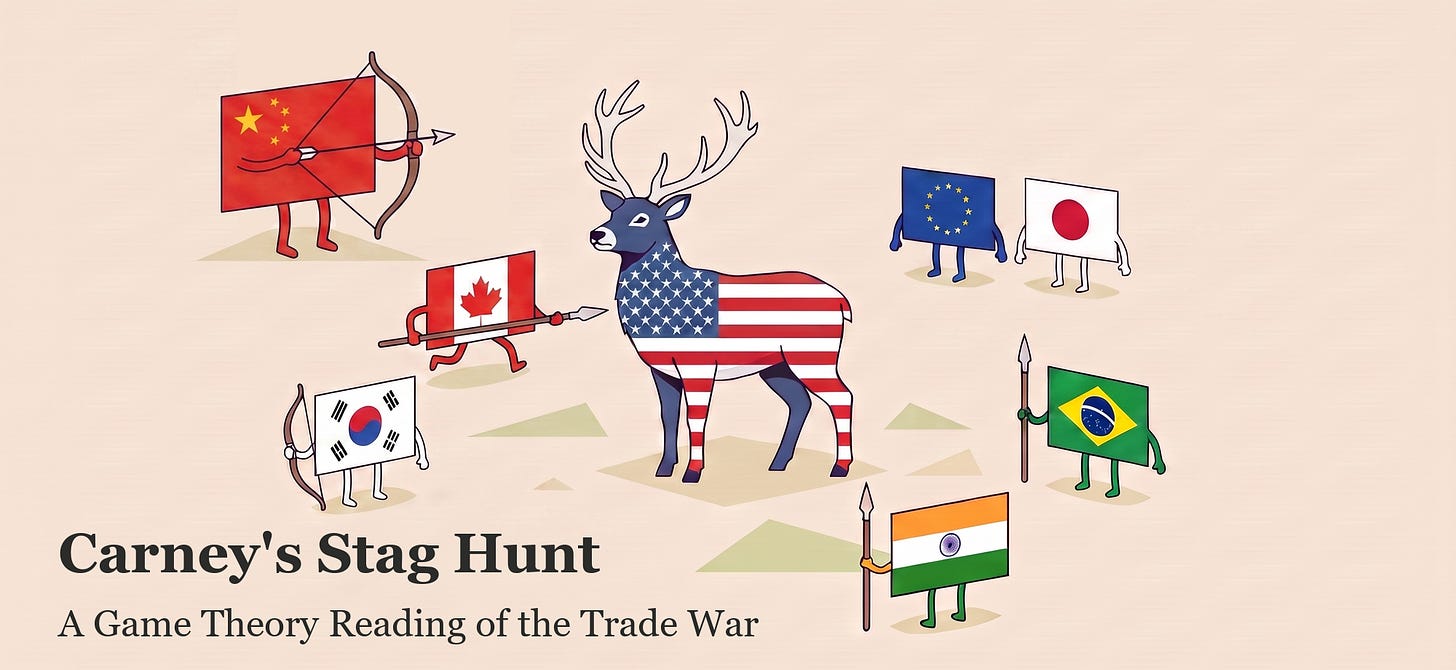
  • China may be able to win a trade war against the US. Canada, on its own, cannot, and Carney knows it. His real game is to build a coalition of middle powers that together can force Washington to retreat.
  • The game has a name: the stag hunt, from a parable by the philosopher Rousseau. Hunters can bring down a stag only if they collectively resist the easy way out and commit to hunting together.
  • It is a prisoner’s dilemma played repeatedly, and in this repeated game, Washington is killing the reward for the easy way out. As soon as a trade negotiation settles, it breaks the promise, so cutting a deal no longer pays.
  • In this game setting, the winning reply is coalition of middle powers playing tit for tat against the U.S. South Korea, Brazil and India seem to be edging toward joining the stag hunt.
  • The EU and Japan has held back from playing tit fot tat, restrained by the threat of security alliance withdrawal by the U.S. The Middle East conflict, though, is devaluing that security card.

Canada cannot win a trade war against the US

Canada seems willing to fight a tit-for-tat trade war with the US. Carney has promised to match US tariffs “dollar for dollar”. Tit-for-tat is the strategy Robert Axelrod showed to be the winning play in repeated games, but it deters only when the retaliation is painful enough. As chart 1 shows, Canada sends 77% of its exports to the US, while only 17% of US exports go to Canada. Canada can attempt surgical strikes at politically painful points, such as goods from the battleground states of the midterm elections, but it cannot win a full trade war with the US. So what is Carney doing?

Mark Carney's Stag Hunt | Speevr
Chart 1

Bow to the US demand or else

To see his game, first look at the game every middle power is in since Trump 1.0. His trade war forces the same two choices: bow to his demand, or get drawn into a trade war and be punished for it. If you resist while other countries bow, you alone are excluded from the US market. The rational strategy for small and middle powers is to appease.

Round one: everyone bowed, and it was rational

That is exactly how round one played out. South Korea, threatened in 2017 with the scrapping of the United States-Korea Free Trade Agreement (KORUS), bowed within months. It agreed to cap its steel exports to the US and let the US keep its 25% tariff on Korean pickup trucks for another 20 years, until 2041. Canada bowed too: it accepted Washington’s terms in the renegotiation of the North American Free Trade Agreement and settled quickly. Settling fast kept the cost small. It was rational appeasement, the calculated concession Daniel Treisman modelled, and in a one-off game, when you expect the trade war to be transitory, it is the right play. The EU and Japan are not exactly middle powers, but they too are settling for a rational appeasement strategy, as Washington has bundled trade with security.

The payoffs: why bowing always wins a one-off game

Chart 2 puts numbers on the game. They are illustrative payoffs, not measurements: zero means break even, positive means come out ahead, negative means lose. Bow to the US demand and win a tariff exemption while your rivals stay tariffed (+2). Fight together, and force Washington to retreat: everyone gains modestly, nobody gains an edge (+1). Bow together and let the US extract the maximum from each (−1). Fight alone, and be made an example of (−3). The +2 is actually a mirage, as the rational response in this prisoner’s dilemma is always to bow, so the one-off game lands at all-bow, −1 and −1.

Mark Carney's Stag Hunt | Speevr
Chart 2

In Trump 2.0, appeasement no longer pays

The structure of the game changes when the US reopens what it has already settled, reneging on its promises. The EU settled and faces new threats in Trump 2.0. Canada faces a new demand as Trump scraps the USMCA he agreed in round one. Korea faces a demand for $350 billion in cash. Seoul refused, and slow-walked the negotiation. Washington answered by putting the security alliance itself on the table. On August 17, Trump ordered joint exercises “substantially reduced”, as the USS George Washington, the only forward-deployed US carrier, left Yokosuka for the Middle East.

When Washington reopens every settled deal, the payoff to bowing alone shrinks to zero, literally, in the right panel of chart 2. A repeated game in which no deal sticks is no longer a prisoner’s dilemma. It is a different game, with a different winning move. Table 1 sets out how each player read round one, and what it is doing about it now.

Carney’s game: Rousseau’s stag hunt

The repeated game has a name. It is the stag hunt, from Jean-Jacques Rousseau’s parable: hunters can bring down a stag only if they collectively resist the easy way out and commit to hunting together. In my view, this is the main message Carney tried to send at Davos. Said in front of every government at once, his speech literally said that we are not playing a one-off game, and that the world is not going back to an old normal where promises are kept.

Davos speech had multiple purposes

The speech carried two messages, one for each audience he needs. To fellow middle powers: the game is repeated, and the big player does not keep the rules. “The middle powers must act together because if we’re not at the table, we’re on the menu.” To the Western allies such as the EU, Japan and South Korea, for whom the security alliance with the US was the stake restraining them from playing tit for tat, the message was harsher. They should not count on the old order resting on American hegemony supplying public goods. If the security alliance will not be reliable again even when Trump is gone, then the trade concessions Japan and the EU pay to keep it are payments for a service no longer rendered.

Carney is playing Stag Hunt game to reach a new equilibria

So the game Carney is playing is not a simple tit-for-tat game. He is trying to play the stag hunt, persuading his fellow middle powers that we are in a repeated game where bowing to a US demand brings less value, because the US does not stand by its promises. Carney’s itinerary shows that he is actively recruiting fellow hunters. He sealed a strategic partnership in Beijing days before taking the Davos stage, invited Modi and Lula to the G7 he hosted, and went to Delhi in March to launch a trade partnership. Carney is not trying to win a trade war with the US solo. He is playing the coordination game in which the stable equilibrium is for middle powers to collectively play tit for tat.

Mark Carney's Stag Hunt | Speevr
Chart 3

Table 1 below shows how the trade negotiation strategy changed from rational appeasement to tit for tat and the stag hunt for Canada, India and Brazil. South Korea is combining rational appeasement and the stag hunt, while clearly dragging its feet in responding to the US demand. In the table, we also show the lesson each country drew from its negotiation in round one. The US reneging on its trade deals pushed the middle powers out of appeasement and into the stag hunt.

Mark Carney's Stag Hunt | Speevr
Table 1

The most coerced are the most credible

Canada is the most economically dependent ally, Korea the most militarily dependent. Yet these two are the most openly defiant, while the less dependent EU and Japan accommodate. What makes the defiance credible is that public opinion is behind it. As chart 4 shows, only 45% of South Koreans now view the US favourably, down from 77% in 2024, and 85% disapprove of the tariffs. Canadian favourability has fallen to 33%, from 54% two years ago. Carney and Korea’s President Lee lead electorates for which capitulation is politically impossible, which makes their refusal credible in Washington.

Mark Carney's Stag Hunt | Speevr
Chart 4

Can Carney succeed?

As a fellow economist, I am rooting for the former central banker with a doctorate in economics from Oxford. But it is hard to say whether Carney will succeed. Coordination games often fail when players cannot credibly commit. Carney has probably committed himself to his strategy, but Canada can still switch when the going gets too painful, and the US still holds a strong hand keeping its targets divided. I do see cracks in the divide-and-conquer strategy, though. Korea has stopped complying. Brazil and India are showing stronger resistance. And the security card the US is deploying against the EU and Japan is being eroded by the Middle East conflict: the might of the US military now looks smaller than it was assumed to be, and a critical element of that card, the aircraft carrier USS George Washington, is literally gone from the western Pacific. That must be making Japanese policymakers rethink the benefit of the security alliance, and how much Japan should sacrifice to maintain it.

Subscribe to receive updates from Japan Macro Advisors

Most recent by Japan Macro Advisors

Share this page

Mark Carney’s Stag Hunt

Canada cannot win a trade war against the US solo, and Carney knows it. In this article, I explain the global trade war through