

Download
Key takeaways
- As the Diet session concluded on Wednesday, 17 December, Prime Minister Takaichi Sanae faces several questions about how to bolster her government in the new year.
- With neither Ishin no Kai nor the Liberal Democratic Party (LDP) wholly satisfied with their partnership – and the Democratic Party for the People (DPFP) emerging as a constructive partner – she and the LDP may be thinking about changing the ruling coalition.
- Meanwhile, with Takaichi’s approval ratings still robust, she may also be contemplating a snap election that could strengthen her bargaining position in the Diet, though it is far from guaranteed that she will gamble on an early election.
The extraordinary session of the Diet closed on Wednesday, 17 December with the government’s supplemental budget passed – it cleared the upper house on 16 December with the support of the Democratic Party for the People (DPFP) and Kōmeitō – and the joint Liberal Democratic Party (LDP)-Ishin no Kai electoral reform bill stalled in the lower house’s political reform special committee.
When looking at the choices outlined here, the extraordinary session ended with Takaichi conceding little to Ishin no Kai. She was able to avoid using her more powerful tools, extending the session or calling a snap election, on legislation about which her party is at best lukewarm. Meanwhile, Ishin was forced to accept that it had failed to secure a major accomplishment from its partnership with Takaichi during the legislative session.
As the political system heads into recess for a month until it reconvenes in mid- to late January for an ordinary session, the prime minister appears to be at a crossroads as she considers how she can bolster her government, deliver on her ambitious agenda, and increase her chances of staying in office for a longer duration.
Can Ishin no Kai and the LDP patch up their relationship?
Two months into the LDP’s partnership with Ishin no Kai, frustrations are mounting on both sides. Ishin no Kai is discovering that, although they are aligned on a number of policy issues, it is not in fact in the driver’s seat when it comes to setting the government’s priorities. Takaichi of course agreed to an extensive set of promises when she negotiated the pact with Ishin no Kai, but the junior partner has learned that its leverage over the prime minister is in fact quite limited. Takaichi herself does not seem to be eager to cast the party aside, but the debate over the electoral reform bill revealed that she is not going to let the pact with Ishin no Kai limit her freedom of maneuver or make the task of managing the LDP itself more difficult.
The upshot is that once Ishin no Kai voted Takaichi into the premiership, its leverage over her and the LDP was immediately diminished; the party can threaten to leave the relationship, but it cannot threaten too much or it will either (a) not be taken seriously by the LDP or (b) irritate the LDP to the point of seeking alternative partners. This may already have happened. Meanwhile, senior Ishin no Kai leaders are clearly unhappy with the LDP, if not Takaichi herself, believing that the ruling party made light of Ishin no Kai’s demands.
At a meeting with Ishin no Kai co-leaders Yoshimura Hirofumi and Fujita Fumitake on 16 December, Takaichi said she hoped that the joint electoral reform bill will pass in the new year and appeared to want to preserve the relationship. However, this meeting did little to ensure that the partnership will survive much longer. Takaichi has already made clear that she will put her and the LDP’s interests before Ishin no Kai’s, meaning that she could call a snap election in early 2026 even if Ishin no Kai would prefer to wait until the LDP-Ishin no Kai partnership delivered on one of Ishin’s major priorities, either cutting the number of legislators or passing an “auxiliary capital” bill. And even if Takaichi waits until later in 2026 to call a snap election, there is no guarantee that she will spend political capital on Ishin’s priorities if the LDP itself is not interested.
Accordingly, the future of the LDP-Shin partnership may rest less on Takaichi’s decision-making than on Ishin no Kai’s decision-making. The implicit messaging from Takaichi and the LDP is “we control the government, we have other options (see below), and if you think you will fare better as an opposition party the door is that way.” The question is whether Ishin no Kai is willing to accept that it will not in fact be able to dictate terms to the Takaichi government and may have to settle for less than it expected. If it cannot, the party itself may decide to leave the next time there is friction.
Will the LDP try to replace Ishin no Kai with the DPFP?
At her press conference marking the end of the Diet session, Takaichi was asked whether she would seek to add an additional coalition partner or replace Ishin no Kai. The prime minister declined to comment, but after the DPFP’s support enabled the government to pass the supplemental budget and with the LDP and DPFP negotiating on how to include the DPFP’s proposal for raising the income tax threshold in the FY2026 tax plan, there is naturally speculation that the government could seek a more formal partnership with the DPFP, perhaps even a full coalition instead of the external cooperation agreement that the LDP made with Ishin no Kai.
For the DPFP, a coalition with Takaichi could make some sense. After performing strongly in the 2024 general election and 2025 upper house elections, DPFP leader Tamaki Yūichirō and his party have seen their fortunes wane after Tamaki’s abortive attempt to assemble a coalition to support a bid for the premiership. The party could be hoping that a coalition enables it to deliver on its promises – such as the income tax threshold proposal – and raise its profile, perhaps enjoying a bump in its standing from being associated with the popular Takaichi. The LDP, meanwhile, may also find working with the DPFP easier than Ishin no Kai (Takaichi backer Asō Tarō reportedly prefers the DPFP to Ishin no Kai, possibly as much for stylistic and aesthetic reasons as for politics and policy). The party’s senior lawmakers are more experienced and polished and may also have more realistic expectations for their role as a junior partner.
Of course, a coalition with the DPFP would not be without complications. RENGO, the organized labor federation that is the DPFP’s (and the Constitutional Democratic Party’s [CDP]) principal backer, has expressed its opposition to the party joining a Takaichi-led government. Meanwhile, with the DFPP pushing a joint bill with Kōmeitō to restrict corporate political donations, a bill strongly opposed by the LDP, one party or the other would have to shift on this question, hardly an auspicious beginning for a new coalition. Finally, if the government sought to replace Ishin no Kai with the DPFP, it would lose its one-seat majority in the lower house – the two parties would be seven seats short of a majority – though it would gain a majority in the upper house since the two parties would combine for 125 seats in the 248-seat chamber.
Could the LDP get back together with Kōmeitō?
With Kōmeitō backing the supplemental budget and reserving the option of backing LDP candidates on a case-by-case basis – a possibility still intact now that the LDP did not push hard for cutting the number of legislators – it is worth asking whether it would be possible for the longtime coalition partners to reunite. In the near term, this option is still unthinkable. As with the DPFP, the LDP and Kōmeitō would still be at odds over the issue that ostensibly broke the coalition in the first place, restrictions on corporate political donations. Kōmeitō would still worry that its supporters could punish its candidates for backing a hawkish Takaichi government. Takaichi and the LDP, meanwhile, would be reluctant to bring Kōmeitō back into the policymaking process as they are ramping up efforts to update the three national security documents, expand defense spending, relax arms exports restrictions, and reform Japan’s intelligence system, all policies that would be more difficult to achieve with Kōmeitō still in the government.
Will Takaichi call a snap election in Q1 2026?
This is, of course, the single biggest question hanging over the political system heading into 2026. The prime minister herself has offered few hints about her intentions. Asked about a snap election in the press conference Wednesday, she said that she “simply does not have time to think about dissolving the Diet” when the government is focused on finalizing the FY2026 budget and tax plan.
But on the face of it this is a weak denial, since both will be finalized before the end of the year. There is little question that she is contemplating this option, not least since her approval ratings remain extraordinarily high even if they have slipped slightly in more recent polls.
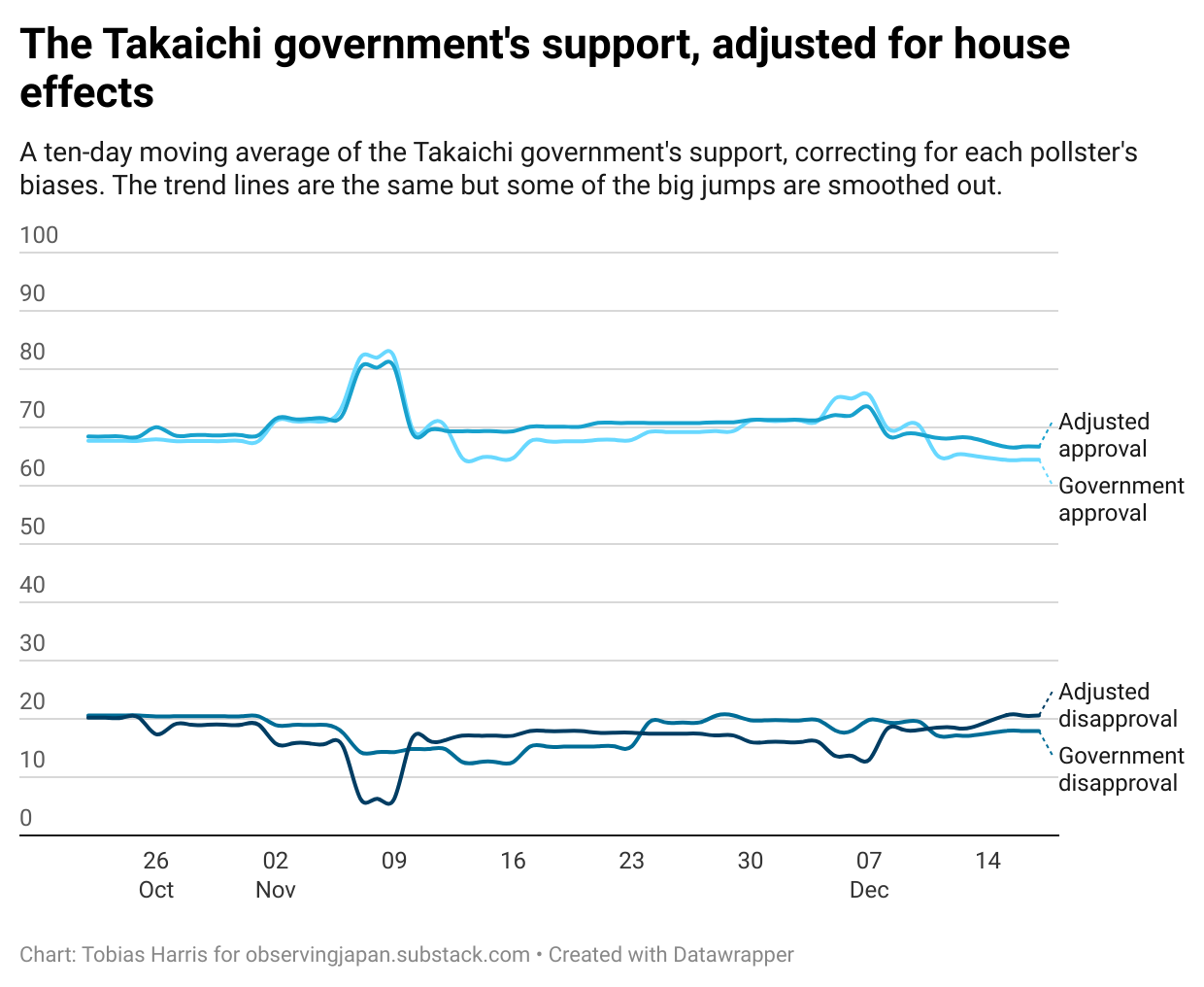
To be sure, the LDP may not be uniformly in favor of a snap election, whether because of fears that Takaichi’s coattails may not be as long as her approval ratings would
suggest, fears of the impact of the loss of Kōmeitō support for many if not all LDP candidates, and fears that Sanseitō could still impact the race in marginal seats even with Takaichi competing for many of Sanseitō’s voters. There may also be some reluctance to contest a general election in the winter, when large parts of the country are snowbound. Others may worry that Takaichi may not have a compelling reason to call a snap election beyond her political advantage, which could also hurt LDP candidates. Meanwhile, Takaichi herself may be genuinely conflicted about whether to call an election before her government has accomplished much.
Ultimately if Takaichi were to call an early election, she would essentially be gambling that even if the LDP does not regain an absolute majority – if it were to win the thirty-four seats needed for a majority it would be the LDP’s third-best performance under the current system after 2012 and 2005 – the party could increase its seat total and improve its bargaining position vis-à-vis its coalition partner(s) or even opt for a minority government and hope that it can divide and conquer among the opposition parties and avoid a no-confidence motion. Perhaps another advantage of calling a snap election is it could, depending on the results, enable the LDP to deprive the CDP of some of the prizes it won after the 2024 general election, most notably control of the budget committee. Retaking the chair of the lower house budget committee for the LDP may be enough to justify a snap election, even if projections suggest that the LDP would not win enough seats to gain a majority of its own.
The coming weeks will see rampant speculation about Takaichi’s thinking on this issue, but either way she will not be able to act before the Diet reopens in January, since political custom would make it difficult for her to dissolve the Diet when it is not in session. Meanwhile, if she were to call a snap election before the budget passes, she would have a narrow window in which to do it. She would need to leave enough time in February for the lower house to deliberate and pass it, preferably by late February since the government would want to ensure that the budget would be enacted even if it were held up by the upper house and thus would need it to pass at least thirty days before the end of the fiscal year on 31 March. While the date for opening the ordinary session is unknown – and may depend on the travel schedules of the prime minister and cabinet ministers – she would need to dissolve the Diet immediately upon its convening and then hold a general election at least twelve days and no more than forty days later, leaving Sunday, 8 February or Sunday, 1 February for a more abbreviated campaign as the most likely dates for a snap election.