A month ago, the S&P 500 was a level to “buy.” After the horrors of the past couple of trading sessions, any level above 5100 is a “short.” It's hard to ‘unsee' that.

The 30–35 minute window during which the E-mini futures (short) squeezed higher by 8% on a news headline—that the White House was considering a 90-day delay in tariffs, later denied—was slow enough to trigger a few discretionary panic trades and forced liquidations, followed by a slow, acid-drop-style move higher.
The “funniest” margin call stories always seem to come from those whose day job isn’t managing money. From the Uber driver getting margin called while chauffeuring a portfolio manager—who’s also trying to avoid the same fate—to the retired banker with an oversized position who ends up digging up the turf instead of relaxing on the golf course. What can you do, eh?
U.S. Effective Tariff Rate (1790-2024)
Andrew Walters has calculated the effective tariff rate charged on U.S. imports during the period 1790–2024—see below. Data and calculation methodology are available upon request.

Meeting Notes – John Thomas on US Tariffs and Latest from D.C.
Date: April 7, 2025
1. Trump’s Overall Intent and Negotiation Approach
Trump genuinely views the current situation as an opportunity to fundamentally rebalance global trade, using tariffs strategically as negotiation leverage. He is not bluffing; tariffs may be reduced through negotiations but will not be eliminated entirely. Trump's negotiation style involves aggressive initial positions (anchoring), symbolized by the “my button is bigger than yours” approach, signaling significant tariff hikes initially before moderating slightly. He aims to quickly finalize key trade agreements within weeks.
2. Trump’s Long-Term Political Perspective and Base Support
Trump is uniquely positioned as the first U.S. president genuinely driven by a long-term strategic outlook, enabled by the fact that this will be his second and final presidential term (no “third term”), despite rhetoric suggesting otherwise. This affords him greater freedom from immediate political pressures. He remains unwaveringly committed to a tough stance, particularly towards China and the EU, and believes strongly he holds more leverage. Trump is determined to “stare into the whites of the eyes” of China and Europe longer than most observers anticipate, demonstrating his insistence on projecting strength and resolve. He remains indifferent to Wall Street’s short-term reactions, instead explicitly prioritizing Main Street interests. With robust and steady support from his political base (around 93%), Trump sees no reason to shift his aggressive approach or soften his stance in the near future. While mindful of maintaining control of the House politically, Trump believes he can endure political pressures far more effectively than his predecessors.
3. Trump's Stance toward Wall Street vs. Main Street
Trump has shifted his focus decisively away from Wall Street, explicitly prioritizing Main Street by pushing policies aimed at reshoring manufacturing jobs, particularly to electorally significant states like Ohio and Michigan. While he previously touted stock market performance as a key achievement, it is now clearly secondary in his policy considerations. He may again begin to emphasize Wall Street performance later on, but it is explicitly not a priority at present.
Scott Bessent made a pact with Trump to stand by him through thick and thin—this was a precondition before accepting the role of U.S. Treasury Secretary.
4. Country-Specific Negotiations (Chile)
Countries viewed unfavorably due to political alignment, such as Chile—whose socialist government openly supported Kamala Harris—will experience notably tougher negotiations. Chile, in particular, is highly anxious about these unfavorable prospects. Businesses within these politically disadvantaged nations are strongly encouraged to bypass their own governments and directly engage with the Trump administration. Such direct negotiations have previously allowed corporate clients to secure beneficial tariff waivers, providing them with significant competitive advantages lasting potentially up to a year or the remainder of Trump’s term.
5. Tariff Pause Scenarios
The administration is considering temporary tariff pauses during ongoing trade negotiations, and White House denials on Monday morning are not entirely accurate. Two primary scenarios have emerged: a 90-day pause (30–35% probability) and a shorter 30-day pause (around 40% probability). Additionally, limited pauses might be granted individually to one or two countries actively negotiating. Given the substantial number of countries seeking agreements, there's also roughly a 50% chance Trump might prefer consolidating these negotiations into one large-scale, comprehensive negotiation to simplify and expedite the process.
6. Negotiations and Concessions with China
Trump intends to remain uncompromising in negotiations with China, convinced that the U.S. possesses superior leverage. He has explicitly identified three crucial demands necessary for meaningful progress: the successful conclusion of the TikTok deal, a firm crackdown by China on fentanyl precursor exports, and explicit commitments by major Chinese industries to relocate (“onshore”) their production into the United States.
7. Symbolic Deals with Allies (Japan, Korea)
Trump seeks symbolic yet politically significant concessions from key allies, particularly Japan and Korea. Specifically, he is fixated on concessions involving autos and rice tariffs—items that, despite their relatively small monetary value, carry substantial symbolic importance. These concessions serve primarily as political victories to demonstrate fairness and strength rather than as measures designed to achieve significant economic impact.
8. Economic Impact and Tariffs as Revenue
Trump explicitly frames tariffs as a type of consumption tax aimed at raising significant revenue for the U.S. government. This tariff revenue is strategically intended for reducing national debt, strengthening domestic manufacturing sectors, and explicitly improving economic conditions and quality of life in Trump's core electoral base states, notably Ohio and Michigan.
9. Deminimis Tax Status
The status of the deminimis tax remains uncertain. Its potential reinstatement or continued suspension has not yet been clarified or confirmed by the administration.
10. Forced Divestment of Chinese-Owned Assets
The administration is actively exploring or moving towards forced divestments of Chinese-owned companies operating in broadly defined strategic sectors, including technology, energy, batteries, and critical infrastructure. A prominent example specifically identified is ZPMC, a Chinese state-owned enterprise that controls roughly 80% of cranes at U.S. ports, making it a notable candidate for potential divestment.
11. Chips Act and Capital Gains Tax
Trump strongly opposes the Chips Act, preferring tax incentives, tariff waivers, and joint ventures over direct subsidies. He is also considering eliminating capital gains taxes entirely and has expressed interest in eliminating carried interest, although this particular change will not appear in the current legislative package.
12. Geopolitical Strategy
Trump views international geopolitical conflicts largely as proxy struggles against China. He explicitly seeks increased U.S. military presence in Greenland and identifies Africa as a critical battleground due to growing Chinese influence, especially concerning China's Belt and Road Initiative and CCP-related debt issues. In the Middle East, Trump supports decisive action against the Houthis in Yemen—including possible Saudi-led ground operations—as Iran distances itself from the group, and he maintains unwavering support for Israel while desiring an end to hostilities in Gaza.
13. Ukraine-Russia Negotiations
Trump aims for concrete diplomatic progress on Ukraine by May, explicitly timed to precede a possible Russian spring offensive. He firmly opposes any U.S. ground troop deployments overseas. Reintegration of Russia into the SWIFT payment system is being considered as leverage in negotiations, alongside the possibility of a ceasefire as a precondition for Russian cooperation. Trump's previous experience with Zelensky left him skeptical, as he felt “backstabbed” after an earlier tentative agreement collapsed. Additionally, there remains skepticism regarding whether Ukraine’s upcoming elections will proceed as planned.
14. Federal Reserve Independence
Trump expects and strongly desires the Federal Reserve to significantly cut interest rates and is currently refraining from public conflict. However, if cuts do not materialize soon, he may escalate pressure and criticism, particularly against Fed Chair Powell, whom he dislikes. Meanwhile, Trump is actively reorganizing banking and financial regulators, merging the OCC and FDIC, effectively dismantling the CFPB, and accelerating bank merger processes.
15. EU Retaliation and Parity
The Trump administration remains highly focused on achieving tariff parity with the EU and is prepared to aggressively counter any retaliatory actions from the EU.
16. Musk’s Influence
Elon Musk does not have direct influence over U.S. trade policy decisions, although he retains a limited degree of access to discussions within the administration.
17. Capital Controls or Depreciation of Dollar
There remains uncertainty about whether the administration may consider implementing capital controls or actively seek depreciation of the U.S. dollar as part of its broader economic strategy.
18. Rare Earths and Ukraine
Trump is explicitly interested in securing unique international agreements concerning rare earth minerals, though Ukraine is notably insignificant in this particular strategic resource area.
19. Tariff Floor (10%)
Once all trade negotiations stabilize, the Trump administration expects a minimum long-term baseline tariff rate of approximately 10% to remain in place. This figure is viewed as the new normal.
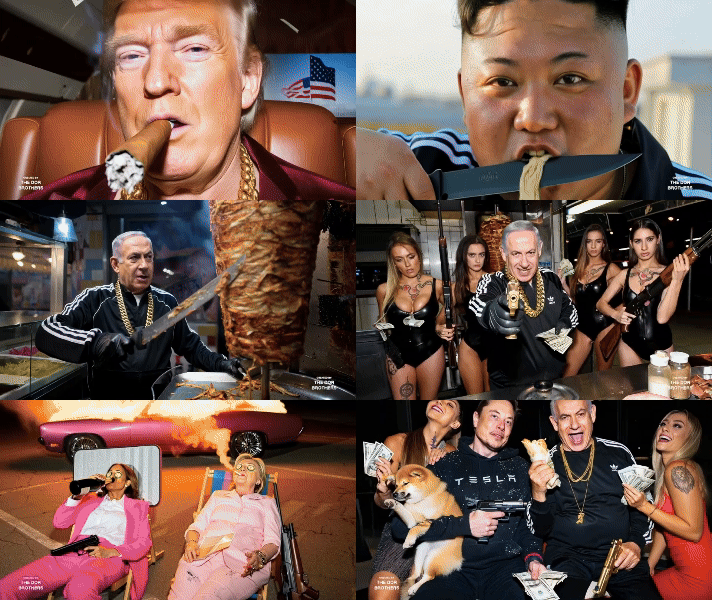
Best GenAI Music Video Yet
This has to be the best AI-generated (music) video yet by some distance — a significant improvement on the original. (Warning: explicit content; headphones strongly recommended.)
Updates
There are a couple of golden nuggets buried in the last update. One should be fairly easy to spot; the other requires a bit of expertise in trade economics to identify—but is also quite significant for the market. The early Easter egg hunt is on!
Lots going on in the world of geopolitics while everyone's busy or distracted with tariffs and market volatility.
And the torture continues…