Sir Alex Younger (4 July 1963 – 2 June 2026)
We were saddened to learn of the passing of Sir Alexander William Younger. Former colleagues at SIS described him as a kind, humble, and exemplary intelligence officer — a characterization consistent with the sharp, thoughtful geopolitical commentary and analysis he later offered.
On a less formal note, among former SIS Chiefs, he stood out for the clarity and insight of his analysis and his contribution to shaping public discourse.
Pros vs. Amateurs
Transcript from a BBC interview in January 2026:
Rob Peston: And I think that's what Mark Carney was saying. Which is why I was sort of asking you about, given that we are all connected, how we get leverage over somebody like Trump or indeed Xi, China, or indeed Putin, the sort of blue strip there where they just think it's all about might is right. How do we impose our more humane values on them?
Alex Younger: I don't have time to do the big vision thing. Can I tell you what I would like for Christmas? 20 global scale technology companies in Europe including the UK.
Rob Peston: Totally. We're not getting them by Christmas, I got to tell you. We might get them in five years.
Alex Younger: But where does America's edge come from? It comes from its innovation tech.
That exchange made me chuckle.
At the time, Trump was threatening to acquire Greenland and European policymakers were visibly rattled. The protests and riots in Iran had already been abruptly put down several days earlier, though many Western media outlets were still reporting as if events remained in full swing. We were inundated with questions about the potential breakup of NATO, a war over Greenland, and imminent regime collapse in Iran.
Sometimes such questions are best ignored. Otherwise, one risks sinking alongside the Iranian navy—or perhaps alongside the angry Iranian fishermen still demanding compensation for their sunken vessels. Minor details, apparently.
The broader problem is familiar: people with megaphones but little inclination to dig beneath the surface retreat into the safety of distance, speculation, and uncertainty. At precisely the moments when nuance and clarity are most needed, they provide neither. The result is usually analysis built on flawed assumptions and frameworks increasingly detached from reality.
Big-picture discussions matter. They have their place. But perhaps they are best reserved for moments of relative calm rather than periods of maximum confusion.
Iran
Younger was also among the first—if not the first—of his peers to publicly acknowledge that the Iran war was not going particularly well. He further observed that Iran's decision to pursue “horizontal escalation” against the GCC initially struck him as foolish, before he quickly came to the conclusion that it was in fact a very smart move.
A couple of weeks earlier, we had noted something similar by way of a simple inductive rule: if both Sir Richard Dearlove (a decidedly less impressive predecessor to Younger) and General David Petraeus (better at explaining wars than winning them) describe Iran's horizontal escalation as “stupid” or “foolish”—particularly with visible frustration or anger—then there is a reasonable chance the opposite may be true, given their respective track records on the region.
As former intelligence professionals, neither was particularly adept at concealing inner feelings—whether through words or body language. Or, even worse, perhaps they had simply never given much thought to a scenario that a longstanding adversary had clearly signaled on multiple occasions.
We have shown time and again that basic Bayesian reasoning, logic, and critical thinking often produce better forecasts than the endless stream of soundbites and speculation that dominates public discourse. In the absence of genuine domain expertise or hard information, they should be the starting point for analysis rather than the pronouncements of celebrity experts and media commentators, which are too often detached from reality and devoid of context.
In reality, Iran's targeting of GCC states was not merely a strategic choice; it was also, from Tehran's perspective, an act of military necessity and self-defence. The GCC ultimately failed to convince the Iranians not to return fire at the origins of attacks on Iranian territory.
Nor were the civilian areas struck by Iranian missiles and drones selected at random. While public protests and condemnations were politically necessary, the targeting itself appeared to follow a discernible military logic rather than indiscriminate retaliation.
Finally, we can always rely on the individual who spent much of his CIA career focused on Iran to deliver a priceless hot take.
One proposal reportedly shared with hedge fund clients for breaking the deadlock in the Strait of Hormuz was to send an oil tanker through the waterway filled not with oil, but with seawater—on the grounds that seawater is less flammable—simply to “see what they've got” (i.e., the IRGC Hormuz series of weaponry).
We'll leave the intelligence professionals to explain why the entire premise of his proposal deeply flawed. There are plenty YouTube video explainers of ‘what they got'. Naval experts can debate whether the decoy cargo would even matter when the relevant threats include sea mines, drones, and anti-ship missiles. And perhaps the 11- and 12-year-olds in science class can explain why filling an oil tanker with seawater (saline solution) rather than light crude (oil) may not be the brightest idea if the objective is to keep it afloat before leaving the port.
At that point, we may as well demand the IRGC to reopen the Strait and suspend the laws of physics while we’re at it. Or perhaps pour some dishwashing soap into the sea and wait for the tanker to magically float back up.
The 47-year enmity between the U.S. and Iran is best understood as a recurring cycle of policy overreach on both sides, each round predictably backfiring—often driven by some of the least capable actors in either system.
U.S-China/Taiwan
For those still interested in U.S.-China relations and the Taiwan question, here's an English translation of a report by CICIR (China Institutes of Contemporary International Relations)—effectively an intellectual arm of the MSS (Ministry of State Security)—which approaches these issues from a Chinese perspective.
A couple of noteworthy excerpts:
“Another salient feature of the great changes in the world is the continued worsening of the global deficits in peace, development, security, and governance. At the start of 2026, the “Venezuela incident” erupted, followed by the outbreak of US-Israel-Iran hostilities. Hegemonism and power politics have intensified the “jungle-ization” of international politics, worsened regional conflicts, and brought greater instability and uncertainty to the world. The Russia-Ukraine conflict has yet to be settled, the Middle East war continues to spill over, and the situation in the Strait of Hormuz is influencing global expectations across energy, shipping, chemicals, and food markets.”
“The entry of the China-US strategic contest into a new phase of strategic stalemate is the second logical premise for our consideration of the correct way for China and the United States to get along.”
The “Taiwan question” is also addressed in the report. It's worth a read.
It is also worth questioning whether every Taiwanese citizen is eager for a fight with the PLA, as many Western China-watchers present as an indisputable fact.
On the American side, Graham Allison and Ian Bremmer had a friendly wager at Davos in January 2025 over whether U.S.-China relations would be in better shape one year later. Allison predicted improvement. Bremmer took the opposite view.
We'll leave readers to decide who won the bet.
One is a highly distinguished Harvard political scientist with longstanding relationships among senior Chinese policymakers and advisers. The other was once a well-regarded political analyst but now appears to spend much of his time marathon podcasting while proudly noting that his firm does no business in China. Evidently, neither circumstance prevents him from offering strong opinions whose shelf life, coherence, and analytical depth often struggle to outlast a typical news cycle. [I’m not inclined toward top-down, superficial, generalist op-eds — unless it's original. I do too much of that myself.]
No doubt Bremmer also has hot takes on artificial intelligence (AI). If AI has not yet managed to eliminate the business model of repackaging soundbites and last week's headlines, the rest of us are probably safe.
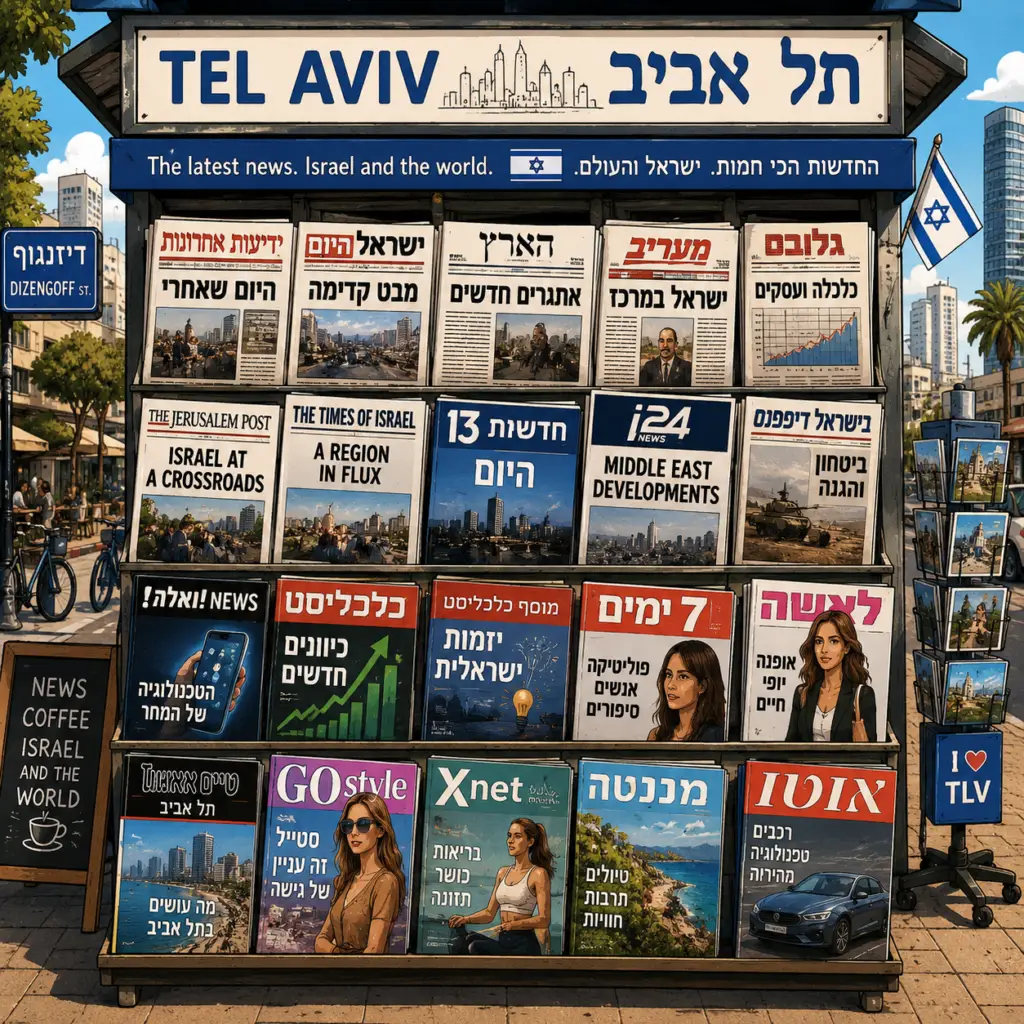
Israel: Hebrew-Language Press Review
Now, from one former SIS (MI6) officer to another with a local perspective.
It is often said that all politics is ultimately domestic. Against that backdrop, and with the Iran front still looming, Israeli politics is becoming increasingly interesting ahead of the general election expected in September or October 2026.

Israel Strategic, Institutional, and Domestic Stability Assessment
The following report synthesizes Israeli press, intelligence commentary, and strategic analysis across military escalation dynamics, domestic institutional transformation, and emerging political violence risk pathways. The material reflects converging assessments from political, legal, and security commentators across multiple Israeli outlets. Mostly from Hebrew language sources for a local perspective.
As always, the sources have been selected by a former SIS operative in the Middle East, with the synthesis our own. Any errors are our responsibility.
We have identify seven broad themes have been identified across the source material:
- Israel–Iran Confrontation: Escalation Failure and Loss of Theater Control
- U.S.–Israel Strategic Divergence and Reassertion of Escalation Control
- Military Strategy Embedded in Domestic Political Constraints
- Institutional Consolidation and Executive Centralization of Security Structures
- Democratic Stress, Judicial Legitimacy, and Internal Polarization
- Netanyahu Trial: Institutional Stress Test and Attrition Dynamics
- Political Violence Risk: Ideological Escalation and Target Formation Dynamics
1. Israel–Iran Confrontation: Escalation Failure and Loss of Theater Control
Israeli and regional security commentary following the recent Israel–Iran exchange converges on a narrow assessment: the episode functioned less as a kinetic confrontation and more as a failed attempt to reassert escalation dominance across multiple theaters, particularly Lebanon and Iran. Reporting across Israeli outlets highlights that what was intended as a controlled escalation cycle instead exposed operational dependence on U.S. constraints and allowed Iran to shape termination dynamics.
At the operational level, the most consequential shift described is the collapse of theater separation. Actions in Lebanon (Dahiyya strikes) and subsequent Iranian responses are assessed as having merged previously distinct arenas into a unified escalation framework.
Iranian action is widely assessed as calibrated but strategically consequential, primarily due to its ability to define escalation closure conditions.
Ronen Bergman, writing in Yedioth Ahronoth, characterizes the outcome as a lack of identifiable Israeli strategic gain and visible dependency on Washington in escalation management.
“It is difficult to identify any Israeli achievement… Israel failed to reignite the campaign, did not draw Trump into it… and allowed Tehran to set the tone.”
From Iran’s perspective, analysts note that the ability to respond directly and end the escalation cycle on its own terms was as strategically significant as the physical damage inflicted.
Ben Caspit in Ma'ariv frames the broader environment as one of increasing multi-front exposure and declining deterrence credibility.
Trump exposed Netanyahu’s bluff (Ben Caspit, Ma’ariv):
Netanyahu learned firsthand … what happens when you put all your eggs in one uncontrolled basket. Trump blew up in his face at once, hurling insults, blasphemies, and even claiming that “without me you would already be in jail, you fucking ungrateful”. That’s how it is in life. When you delegate powers and transfer responsibility for making decisions to foreign hands, you need to take into account that it may backfire on you. When you sell national security for assistance in obtaining amnesty and a quashing of the trial, you may be left with no national security, no amnesty, but with a trial.
Danny Citrinowicz, also writing in Ma'ariv, assesses that Iran has not been deterred by previous campaigns and is operating with increased strategic confidence, while Israel’s freedom of action is structurally narrowing.
Layered onto this external constraint environment is a growing internal governance constraint: Shin Bet veteran Dvir Kariv highlights that political incitement dynamics and institutional delegitimisation are increasing domestic friction costs associated with external escalation decisions, reinforcing broader strategic caution pressures.
2. U.S.–Israel Strategic Divergence and Reassertion of Escalation Control
Israeli political reporting increasingly reflects a structural reassessment of U.S.–Israel coordination, particularly regarding Iran policy. While formal alignment on preventing Iranian nuclear capability remains intact, operational divergence over escalation thresholds has become more explicit in U.S. messaging.
JD Vance, in remarks reported by Ma'ariv, explicitly framed U.S. policy as driven by American interests rather than alignment with Israeli escalation preferences.
“Israel may like it, they may not like it… but fundamentally this is in the best interest of the United States.”
The operational implication is a clearer separation between strategic alignment and tactical authorization. Israel retains coordination, but not escalation autonomy.
Ben Caspit reports in Al-Monitor that U.S. intervention constrained Israeli strike options in Lebanon, particularly around Beirut-linked targets, directly affecting escalation signaling strategy.
This U.S. constraint layer now operates alongside a secondary structural constraint: domestic political instability and institutional fragmentation, which reduces predictability in escalation signaling.
The combined effect is a transition from alliance-based coordination to a managed escalation regime governed by both external and internal veto structures.
3. Military Strategy Embedded in Domestic Political Constraints
Israeli political analysis increasingly situates military escalation as structurally embedded in domestic political survival dynamics rather than purely external strategic calculation.
Gidi Weitz in Haaretz assesses the election of Michael Rabello as State Comptroller as a milestone in institutional capture, marking the erosion of independent oversight structures.
Procedural manipulation during the Knesset voting process, including forced transparency violations reported by Avi Scharf, demonstrates a shift from institutional influence to procedural override capability.
Ben Caspit characterises these developments as “elections under duress,” reflecting breakdown in procedural legitimacy.
Yossi Verter in Haaretz further argues that criminalisation of governance norms is accelerating under executive tolerance, while judicial leadership warnings suggest systemic non-compliance risks extending to electoral legitimacy itself.
4. Institutional Consolidation and Executive Centralization of Security Structures
Israeli reporting highlights a cumulative pattern of executive consolidation across intelligence, oversight, and administrative institutions, reflecting reduced institutional friction and increasing alignment with executive authority.
Alon Ben David in Ma'ariv describes a progressive alignment of senior institutional positions within executive trust networks, reducing traditional bureaucratic independence.
The appointment of Michael Rabello as State Comptroller is interpreted as a structural consolidation milestone, extending executive influence into oversight mechanisms historically designed for independence.
Parallel developments in judicial and legal restructuring efforts—including proposed Attorney General authority fragmentation—indicate a broader reconfiguration of institutional veto points.
Collectively, these changes reflect a transition from informal influence over institutions toward formal restructuring of oversight architecture.
5. Democratic Stress, Judicial Legitimacy, and Internal Polarization
Israeli legal and judicial commentary reflects increasing institutional strain over legitimacy, enforcement authority, and political confrontation.
Esther Hayut, former Supreme Court President, warned in Haaretz of systemic degradation in rule-of-law norms amid escalating political confrontation targeting judicial institutions.
Judicial leadership statements indicate rising concern that institutional delegitimisation is no longer rhetorical but structurally embedded in political discourse.
Attorney General restructuring proposals, including provisions enabling executive dismissal and restriction of prosecutorial authority, are assessed as reducing institutional veto capacity and increasing executive discretion.
Dvir Kariv’s framework on existential target formation directly intersects here, as judiciary members and legal officials increasingly become framed as systemic obstacles rather than institutional actors.
This shift marks a transition of the judiciary from stabilizing institution to contested political arena and target of political legitimacy contestation.
6. Netanyahu Trial: Institutional Stress Test and Attrition Dynamics
The Netanyahu corruption trial is increasingly framed not solely as a legal process but as a long-duration institutional stress test involving procedural, narrative, and political dimensions.
Investigative reporting from Haaretz and Kan public broadcasting highlights systematic attrition dynamics, including repeated delays, shortened proceedings, and disrupted testimony cycles.
Real-time trial data indicates:
- 41% of scheduled testimony days completed in full
- 24% of prosecution cross-examination days completed as scheduled
These patterns are interpreted by analysts not as procedural inefficiency but as sustained attrition strategy affecting judicial throughput.
Simultaneously, narrative simplification campaigns reduce complex legal cases into politically accessible framing devices, weakening public perception of prosecutorial complexity.
The Attorney General restructuring bill is assessed as a structural mechanism to neutralize prosecutorial continuity by fragmenting institutional authority.
Parallel reporting indicates ongoing political pressure channels targeting executive-level intervention mechanisms to suspend or alter trial progression.
Orly Bar-Lev, independent journalist covering Netanyahu’s trial:
1 June – Today we saw another episode of the con artist trying to escape his trial, drag out his testimony, leave a chance for an illegal pardon, and evade a reasonable possibility of conviction and imprisonment … Last week, instead of 3 days of testimony, we got a total of one day of testimony cumulatively, after cancellations and shortenings at the defendant’s request.
2 June – Netanyahu Trial – Day 92 of Netanyahu’s Testimony: Even today, Netanyahu contradicts his previous versions, switches versions, dodges, and when cornered, raises his voice and pounds on the table. And of course, continues to flee from his trial.
Trump deprived Netanyahu of his ‘Bomb Beirut’ election strategy (Ben Caspit, Al-Monitor):
Trump’s veto of Israeli strikes on Hezbollah targets in Beirut, delivered in reportedly a furious phone call with Netanyahu, has deprived [Netanyahu] of a central pillar of his reelection strategy … A source close to Netanyahu [said]: “It puts Netanyahu’s strategy in jeopardy. It places all the achievements of the war so far in doubt, raises questions about Netanyahu’s ability to achieve any kind of victory — certainly not the ‘total victory’ he has marketed to the public since Oct. 7. And this also has a direct impact on the upcoming elections” … Netanyahu appears largely helpless in the face of these public humiliations. A senior Israeli political source [said] that Netanyahu is unable to reject American demands as he did under Democratic leaders.
Trump exposed Netanyahu’s bluff (Ben Caspit, Ma’ariv):
Netanyahu learned firsthand … what happens when you put all your eggs in one uncontrolled basket. Trump blew up in his face at once, hurling insults, blasphemies, and even claiming that “without me you would already be in jail, you fucking ungrateful”. That’s how it is in life. When you delegate powers and transfer responsibility for making decisions to foreign hands, you need to take into account that it may backfire on you. When you sell national security for assistance in obtaining amnesty and a quashing of the trial, you may be left with no national security, no amnesty, but with a trial.
7. Political Violence Risk: Ideological Escalation and Target Formation Dynamics
Israeli security commentary increasingly frames political violence risk as a structural output of ideological escalation dynamics rather than isolated extremist activity.
Dvir Kariv—an expert on incitement & extremism in Israeli society, served in Shin Bet for 22 years, mostly focused on countering non-Arab terrorism—outlines a model in Ma'ariv in which political incitement accelerates a transformation of opponents into existential threats, lowering thresholds for violence and increasing systemic instability risk.
Dvir Kariv outlines a four-stage risk model:
- Existential framing of political opponents
- Moral justification structures for harm
- Physical accessibility of targets
- Symbolic amplification of target importance
This framework is increasingly visible in public discourse surrounding judicial figures, legal officials, journalists, and institutional gatekeepers.
Named targeting of figures such as the Attorney General, Supreme Court leadership, and senior journalists reflects early-stage formation of legitimised target categories within extremist narratives.
The historical precedent of the Rabin assassination is repeatedly referenced as a calibration point for escalation threshold analysis within Israeli security discourse.
Unfortunately, we have not learnt the lessons of Rabin’s assassination, and so the next political assassination is just around the corner. Responsibility always lies with the leader of the camp … A leader sets the tone. He determines the boundaries of what is permitted and what is forbidden. When the leader allows a person to be marked as an enemy, the camp understands. When he remains silent, the camp understands. And when he condemns half-heartedly, with ‘but’ or ‘the other side too’, the camp understands all too well. There is a fine line. A half-hearted condemnation is more dangerous than no condemnation at all. No condemnation is dangerous silence, whereas a half-hearted condemnation is approval disguised as responsibility. It does not extinguish the fire; on the contrary, it fuels it. In the face of incitement and ideological violence, a sharp, clear and immediate condemnation is required.
Democracy without criticism is not democracy. But there is a line that must not be crossed. The line between “you are wrong” and “you are a traitor”, between political disagreement and “you are a danger, and a danger must be removed”. Do not look only for the person under threat. Look for what legitimises the harm done to them. Look for the studio that amplifies it. Look for the leader who failed to intervene in time. That is where the danger begins.
The assassination of Rabin did not begin with three shots, but long before, in a process whereby a man was transformed, in the eyes of certain extremists, from someone who erred into a moral pariah, a traitor, a danger to the nation. Once the opponent becomes an existential threat, not much else is needed. All it takes is one person, certain of their righteousness, who feels that history has entrusted them with a mission. Rabin’s assassin made it clear during his interrogation that he would have found it difficult to carry out the murder without feeling that he had the wind at his back. He said that he was the one who carried out the murder, but that, as far as he was concerned, it was the people of Israel who pulled the trigger…
Within this framework, even partial or ambiguous condemnation by leadership figures functions as a signal amplifier, reinforcing radicalisation feedback loops.
The cumulative assessment is that sustained rhetorical escalation increases systemic probability of political violence emergence through progressive erosion of normative restraint mechanisms.